
AI without expertise automates the mistake.
Rook is Precision Billing's own AI and automation workbench. It was trained for a year on one person's audit, coding and appeal judgment, the founder's, across all of our clients and all specialties. Today it is in full use at one practice, where every function runs through it.
Request a revenue assessmentThe name is short for Rookie.
Local AI only
Rook runs on our own servers and inside our own Microsoft 365 environment. The work is not run through a public AI service.
Trained across all specialties
A year of training on the founder's audit, coding and appeal judgment, across all of our clients.
In full use at one practice
At one practice today, every function runs through Rook exclusively.
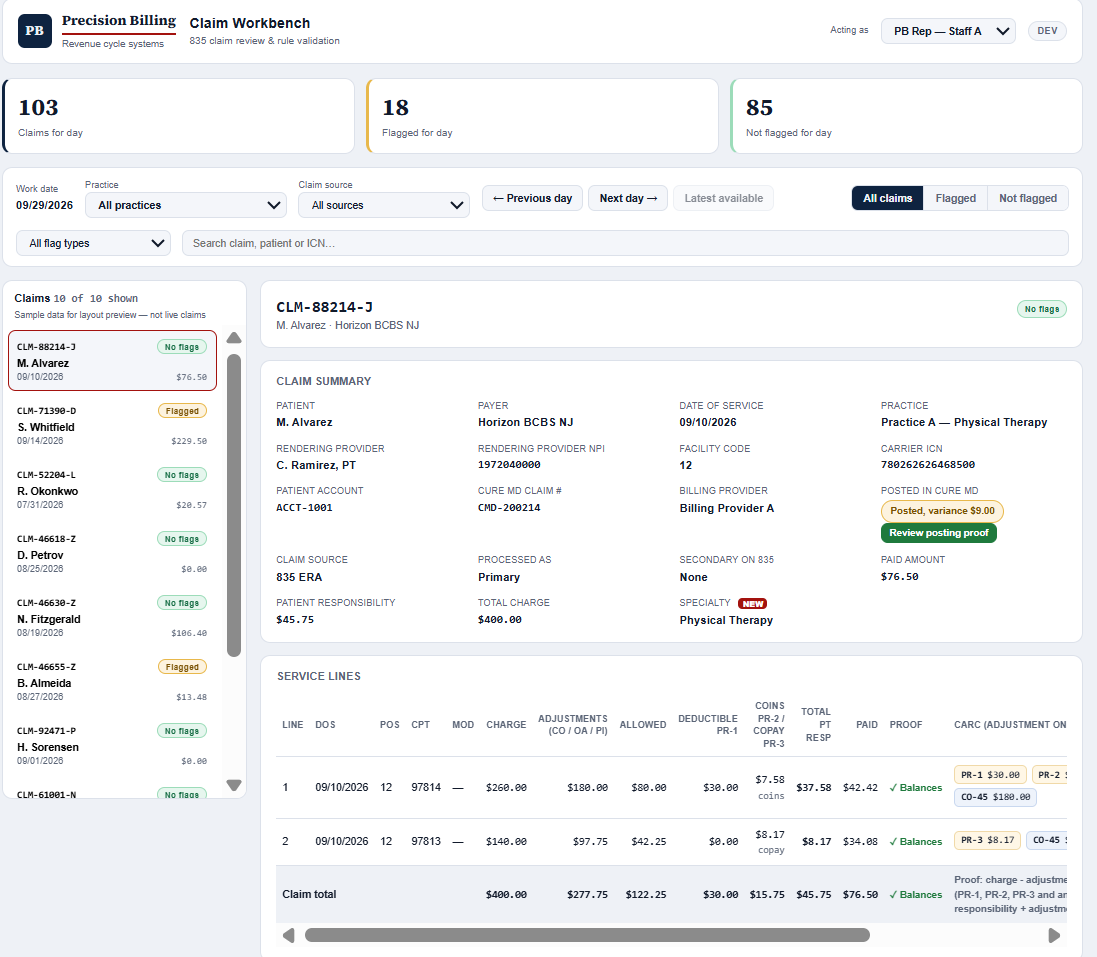
What Rook does with a remittance
Every electronic remittance that goes through Rook is worked the same way. Routine lines finish without a person. The rest stop at a reviewer.
The rules are added to and adjusted as payer policies change.
- Receives each electronic remittance (835) and parses it line by line.
- Triages each line and separates the denials from the adjustments.
- Moves the routine next steps on its own, and sends the rest to a reviewer who decides.
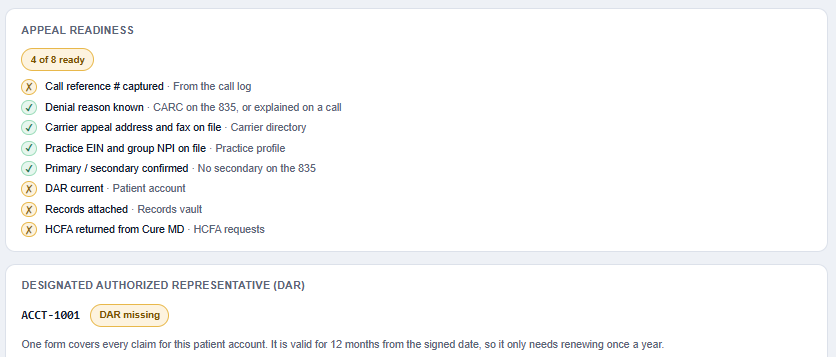
- For an appeal, pulls the authorized-representative form and the record, reads the record and drafts the argument: medical necessity or coding.
- Sends it to the carrier by portal, mail or fax, without the work leaving the system.
Four questions, in this order
These are the first rules Rook was taught. They are the founder's own triage, written down.
Is it a denial at all?
Paid zero is not a denial. Allowed zero is.
A line can pay nothing and still be fully adjudicated, because the allowed amount went to the patient's deductible. Rook reads the allowed amount, not the paid amount.
What does the reason code say?
The denial code decides the argument.
A letter that argues bundling, sent against a pricing adjustment, answers a point the carrier never made.
Which venue?
The line of business decides.
Commercial plans, Medicare, Medicaid, workers' compensation and auto each have their own path. The payer's name is resolved through one table first, because the same payer is spelled differently in every system.
Which clock runs out first?
A claim can be inside one deadline and already outside another.
The carrier's filing deadline and, where it applies, the No Surprises Act windows run separately. Rook tracks both and puts first what expires first.
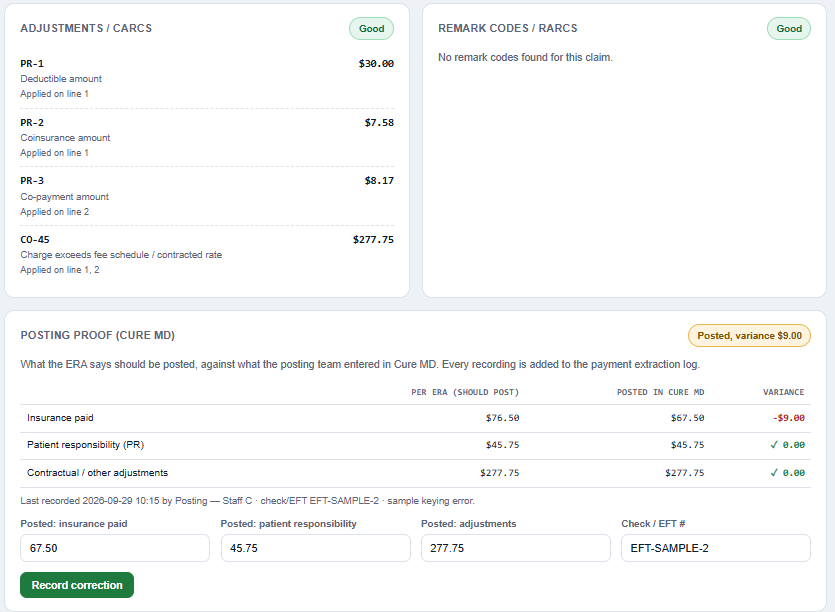
A person decides what Rook cannot.
Routine next steps move on their own. Everything else goes to a reviewer, who decides what happens next. Nothing is guessed: a line Rook cannot place stops and waits.
Rook does not replace the auditor. It carries her judgment to every line of every remittance it works.
Rook in your own environment
For EMR companies, RCM companies and in-house billing staff. We will be offering the denial management this page describes to run inside your own environment, the way Rook runs inside ours.
It will never be one size fits all. Every system, payer mix and workflow is different, so each solution is developed to meet the organization's system requirements and needs.
EMR companies
To plug into the system your customers already work in.
RCM companies
To plug into the operation you run for your clients.
In-house billing staff
For a practice that keeps its billing in-house: the workbench its own staff work denials from.
We are taking the names of organizations that are interested. Tell us what you run and what you would need it to do. What we hear shapes what is built next.
Add your organization to the listWhere it can go from there
- A collaboration
- Further development of what we have built
- Your version, built alongside ours
Tyro
Tyro is the apprentice: newer, and being trained the same way.
In build
The patient journey: a front end built for each office. Benefit verification and authorization are done. The office-specific piece is being built one practice at a time.